
دنبال چی میگردی
?
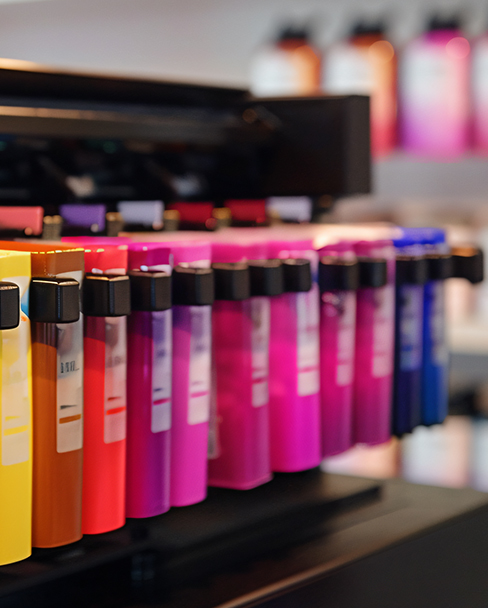
CIJ Solvent vs Ink: What's the Difference and Why Both Are Necessary?
If you operate a Continuous Inkjet (CIJ) printer, you deal with two essential liquids every day: ink and solvent. They look similar, come in similar bottles, and both flow through the same system — but they serve completely different purposes.
Get the mix wrong, and you will face clogged nozzles, poor print quality, and costly downtime. Get it right, and your printer runs smoothly shift after shift.
Here is a straightforward breakdown of the differences and why you need both.
Think of a CIJ printer like a marking factory running inside a compact box. Ink is the "product" that does the marking. Solvent is the "maintenance crew" that keeps the factory running.
Simple analogy: Ink is the paint on the wall. Solvent is the brush cleaner and thinner combined. You need the paint to do the job, but without the thinner and cleaner, the brush hardens and the next coat looks terrible.
| Aspect | Ink | Solvent |
|---|---|---|
| Job | Marks the product (date codes, batch numbers, logos) | Dilutes ink, controls viscosity, and cleans the system |
| Appearance | Colored (black, white, blue, red, etc.) — contains pigment or dye | Clear, colorless liquid |
| Viscosity | Higher (thicker, flows slowly) | Lower (thin, flows quickly like water) |
| Evaporation | Slower — designed to stay wet on the printhead long enough to print | Fast — evaporates quickly to help ink dry on the product surface |
| Consumption | Used for actual printing — consumed based on production volume | Used for viscosity control and cleaning — consumed continuously even when idle |
| Where it goes | Onto the product (some is recycled, some printed) | Evaporates from the ink loop or is flushed out during cleaning cycles |
| Can it clean? | No — ink left to dry turns into a sticky mess | Yes — it dissolves dried ink residue effectively |
It might be tempting to think you can just use ink and skip the solvent, or use solvent as a cheaper ink substitute. Here is why both are indispensable:
Without ink, there is no mark. But without solvent, the ink thickens inside the nozzle, the droplet formation breaks apart, and within hours the printhead is clogged. You cannot have reliable printing with only one of them.
In a CIJ system, the ink circulates in a loop. Solvent evaporates naturally from the ink during operation, making the ink gradually thicker. The printer automatically adds small amounts of solvent to maintain the correct viscosity. No solvent = ink gets thicker and thicker = print quality degrades until the printer stops.
Every time a CIJ printer starts or stops, it runs an automatic solvent flush through the printhead. This clears out any ink that might be sitting in the nozzle or gutter. Without this flush, dried ink would block the nozzle by the next startup.
Ink and solvent from the same manufacturer are chemically matched. The solvent formulation is specifically designed to work with that ink's pigment, resin, and carrier chemistry. Mixing brands or using the wrong solvent can cause chemical reactions, clogging, or safety issues.
Real-world example: A production line using a Videojet 1580 CIJ printer. The 1580 uses Videojet ink for coding and Videojet solvent for makeup and cleaning. If an operator refills with a generic solvent, the viscosity sensor may detect an imbalance, trigger a "viscosity abnormal" alarm, and stop the line — causing costly downtime until the correct fluid is restored.
| Question | Answer |
|---|---|
| Can I print with just ink? | Yes, but only for a short time. The ink will thicken, clog the nozzle, and stop printing. |
| Can I use solvent instead of ink? | No. Solvent has no pigment — it will not leave a visible mark on the product. |
| Which one is consumed faster? | Solvent. It evaporates continuously and is used for cleaning cycles. Typical ratio is 2–4 parts solvent to 1 part ink. |
| Can I use any solvent? | No. Always use the solvent recommended by the printer manufacturer for your specific ink type. |
Ink and solvent are two sides of the same coin. One does the visible work, the other does the invisible work that makes the visible work possible. Neither can do the job alone.
Think of them as a team: ink delivers the code, solvent keeps the system healthy. Respect both, use both correctly, and your CIJ printer will deliver consistent, high-quality codes for years.

پیام بگذارید
اسکن به Wechat :

اسکن در WhatsApp :

 English
 Pусский
 Español
 Português
 العربية
 فارسی
فارسی




 IPv6 شبکه پشتیبانی می شود